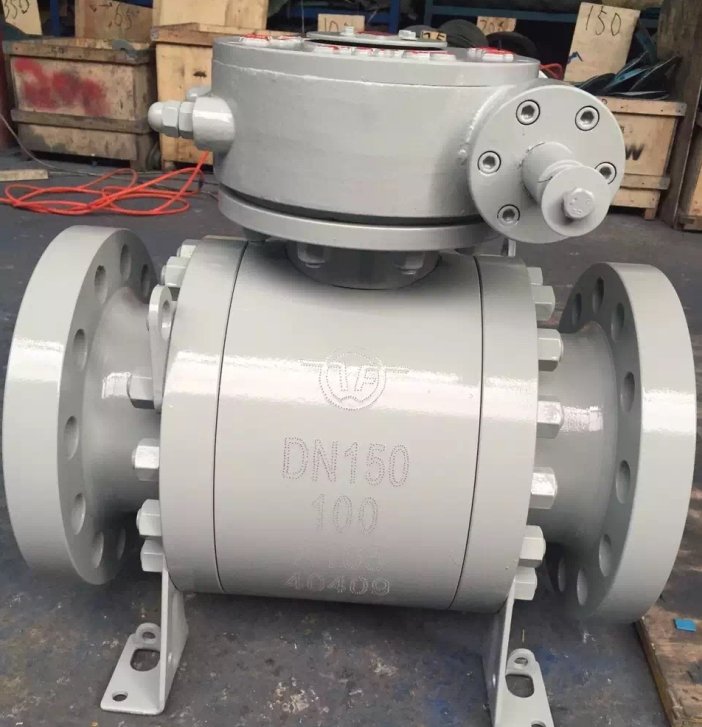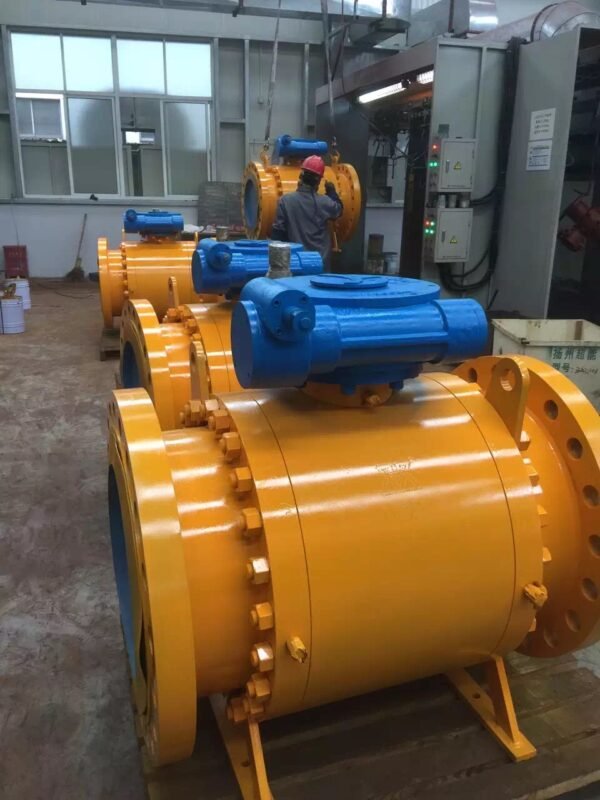

Advantages and operation of ASME standard fixed ball valves
Advantages of stationary ball valves:
1. Emergency sealing with grease injection: In the event of unexpected seat seal failure due to foreign objects in the medium or fire, the grease injection valve provides a quick connection to the grease injection gun. The imported pump allows for convenient and rapid injection of grease into the seat seal, mitigating leakage.
2. Reliable stem sealing and low operating torque: In addition to the standard sealing ring, the stationary ball valve also features an O-ring on the packing gland, ensuring reliable stem sealing with double sealing. The added graphite packing and grease injection minimize stem leakage after a fire. The stem sliding bearing and thrust bearing make valve operation easy.
3. Full bore or reduced bore: Stationary ball valves can be selected with either a full bore or reduced bore structure as needed. For full bore pipeline ball valves, the flow orifice diameter matches the pipeline inner diameter, facilitating pipeline cleaning.
4. Extendable stem: The valve stem can be lengthened according to installation or operational requirements. Extended stem fixed ball valves are particularly suitable for applications requiring underground pipeline installation, such as city gas pipelines. The extended stem size is determined according to customer requirements.
5. Flexible Operation: Utilizing valve seats and stem bearings with a low coefficient of friction and excellent self-lubrication, the valve’s operating torque is significantly reduced. Therefore, even without the provision of sealing grease, the valve can be operated flexibly and smoothly for extended periods.
Operation and Use of Fixed Ball Valves
1. Before operation, ensure that the pipeline and fixed ball valve have been flushed.
2. Valve operation is completed by rotating the valve stem according to the input signal of the actuator: a 1/4 turn (90°) forward rotation closes the valve. A 1/4 turn (90°) reverse rotation opens the valve.
3. When the actuator’s direction indicator arrow is parallel to the pipeline, the valve is open; when the indicator arrow is perpendicular to the pipeline, the valve is closed.