

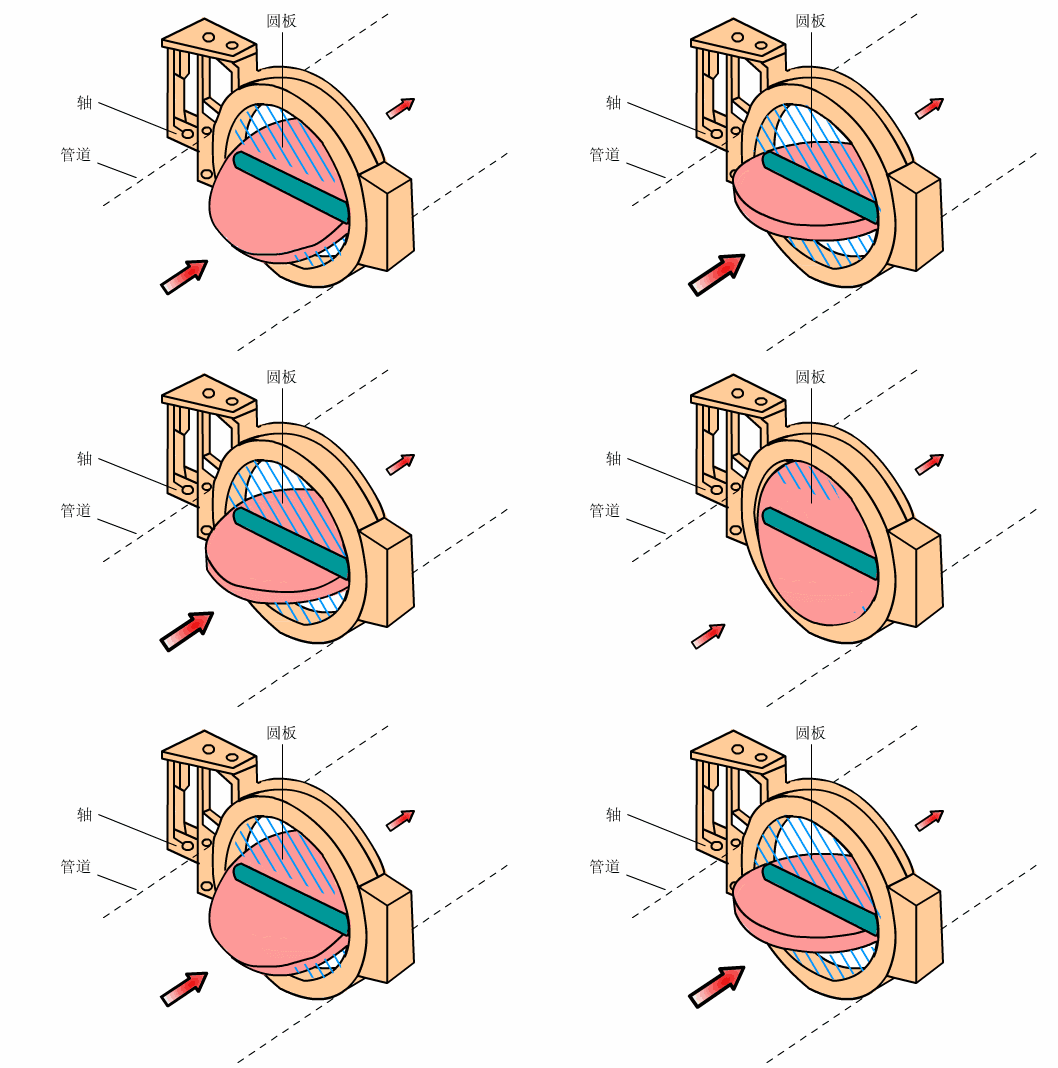
Estructura y principio de la válvula de mariposa:
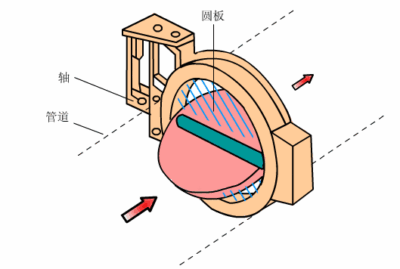
Principio de funcionamiento de la válvula de mariposa.
El ángulo de apertura total a cierre total de una válvula de mariposa suele ser inferior a 90°. La válvula de mariposa y el vástago carecen de capacidad de autobloqueo.; por lo tanto, se instala un reductor de tornillo sin fin en el vástago para posicionar la placa de mariposa. El uso de un reductor de tornillo sin fin no solo le brinda a la placa de mariposa la capacidad de autobloqueo, permitiéndole detenerse en cualquier posición, sino que también mejora el rendimiento operativo de la válvula. Características de las válvulas de mariposa industriales.: resistencia a altas temperaturas, amplio rango de presión aplicable, gran diámetro nominal, cuerpo de válvula de acero al carbono, y anillos de metal en lugar de anillos de goma para los anillos de sellado de la placa de válvula. Large high-temperature butterfly valves are manufactured using welded steel plates and are mainly used in flue gas ducts and gas pipelines for high-temperature media.
1. Butterfly valves feature simple structure, tamaño pequeño, peso ligero, low material consumption, small installation dimensions, rapid opening and closing, 90° reciprocating rotation, and low driving torque. They are used to cut off, connect, and regulate media in pipelines, exhibiting excellent fluid control characteristics and sealing performance.
2. Butterfly valves can transport slurry with minimal liquid accumulation at the pipe opening. They achieve good sealing even at low pressure. 3. Excellent regulating performance.
4. The streamlined design of the butterfly plate minimizes fluid resistance loss, making it an energy-saving product.
5. The valve stem is a through-stem structure, heat-treated for excellent comprehensive mechanical properties, resistencia a la corrosión, and scratch resistance. Durante la apertura y el cierre, el vástago de la válvula solo gira, without vertical movement, minimizing damage to the stem packing and ensuring reliable sealing. It is fixed to the butterfly plate with a tapered pin, and the extended end features an anti-blowout design to prevent the valve stem from breaking off in case of accidental breakage at the connection point.
6. Connection methods include flange connection, wafer connection, butt weld connection, and lug wafer connection.
Features of butterfly valves
1. Easy and quick opening and closing, labor-saving, low fluid resistance, suitable for frequent operation.
2. Simple structure, tamaño pequeño, short structural length, compact volume, and light weight, suitable for large-diameter valves.
3. Can transport slurry with minimal liquid accumulation at the pipe opening.
4. Achieves good sealing under low pressure.
5. Good regulating performance.
6. Large effective flow area in the valve seat channel when fully open, resulting in low fluid resistance.
7. Low opening and closing torque. Because the media acts on both sides of the disc on the rotating shaft almost equally, the torque is generated in opposite directions, thus requiring less effort to open and close.
8. Sealing surface materials are generally rubber or plastic, resulting in good low-pressure sealing performance.
9. Easy installation.
10. Flexible and labor-saving operation; manual, eléctrico, neumático, and hydraulic operation options are available.