

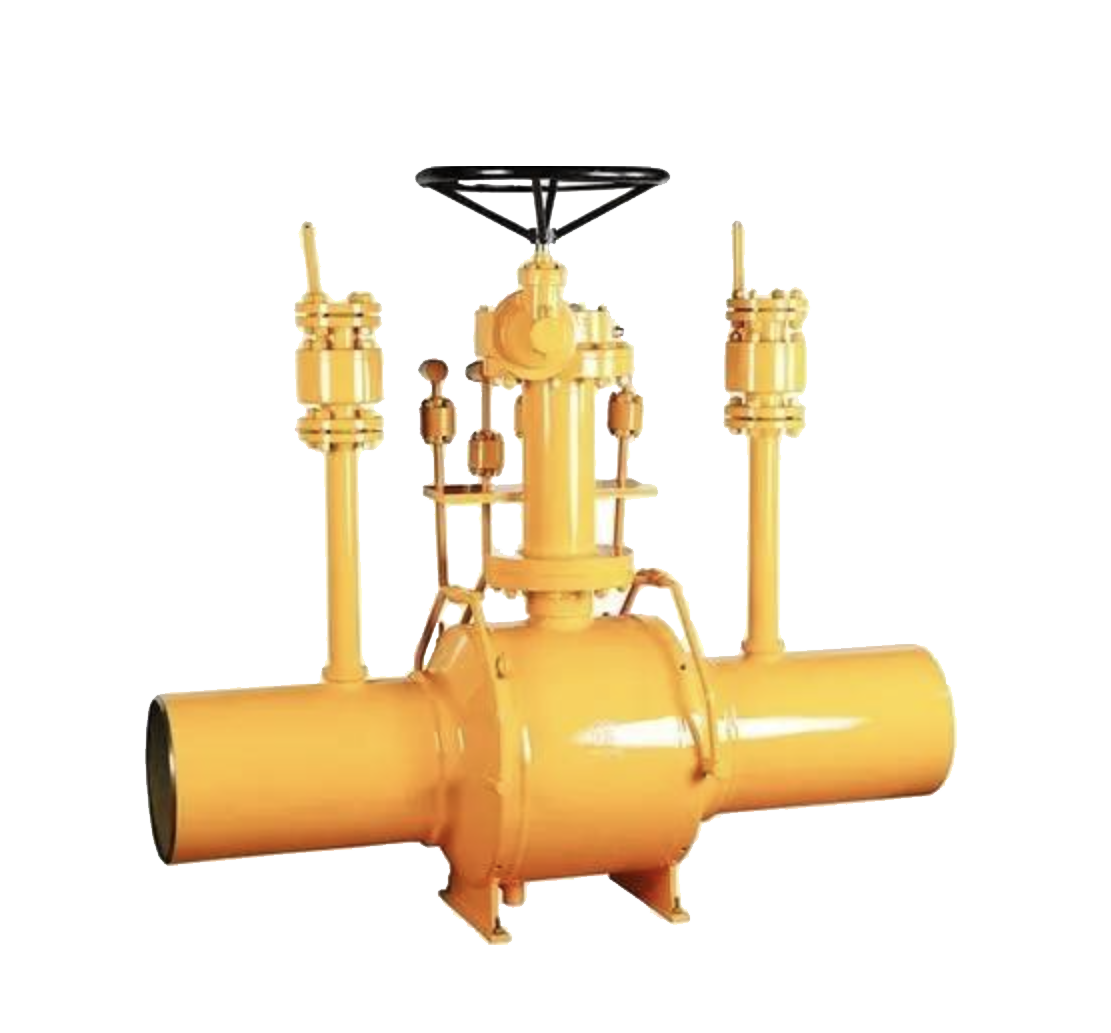
Q61F صمام كروي ملحوم بالكامل: أداة حماية قوية ومتينة لخطوط أنابيب السوائل الصناعية
The Q61F all-welded ball valve features an integral welded structure, offering significant advantages over traditional flanged ball valves, including zero external leakage, lighter weight, and longer service life. It is an ideal choice for urban gas, heating networks, البتروكيماويات, and natural gas pipelines. This article will comprehensively analyze the Q61F all-welded ball valve from aspects such as model designation, technical parameters, structural features, core advantages, main applications, certification standards, and selection recommendations.
1. Model Explanation: What do the symbols in Q61F represent?
Q61F is the most common all-welded ball valve model. The meanings of the letters and numbers are as follows:
Code Meaning Explanation
Q Ball Valve Valve type code
6 Connection method: Butt Welding Both ends of the valve are directly welded to the pipeline
1 بناء: Floating Ball, Straight Through The ball has no fixed support; sealing is achieved by the medium pressure pressing against the outlet-side valve seat.
F Sealing surface material: Polytetrafluoroethylene (بتف) Soft sealing structure with excellent sealing performance.
In addition, there are derivative models such as Q61F-16C and Q61F-25C, where “16” indicates a nominal pressure of 1.6MPa, و “C” indicates that the valve body is made of carbon steel. “Q61F High-Pressure Welded Ball Valve” is designed for even higher pressure conditions.
2. Technical Specifications
The Q61F fully welded ball valve covers a variety of specifications and operating conditions. The following are the main parameter ranges:
Parameter Item | Specification Range
القطر الاسمي (الاسم المميز) | DN15 ~ DN1200 (some up to DN1400) –
القطر الاسمي (NPS) | 1/2 inch ~ 48 inch
الضغط الاسمي (ب.ن) | PN1.6 ~ 6.4MPa (up to PN16 ~ PN420) –
تصنيف الضغط (فصل) | Class150 ~ Class2500
Applicable Temperature Range | -196℃ ~ +650℃ –
الوسائط القابلة للتطبيق | ماء, زيت, غاز, بخار, الغاز الطبيعي, الغاز المسال, and some corrosive liquids –
مادة جسم الصمام | Carbon steel (WCB, A105, 20# فُولاَذ, إلخ.), stainless steel (304, 316, CF8, CF8M, إلخ.) –
Ball Material | الفولاذ المقاوم للصدأ 304 or 316 (precision ground) –
Stem Material 2Cr13, الفولاذ المقاوم للصدأ
Sealing Material: بتف, RPTFE (Reinforced Polytetrafluoroethylene), شركته تنوي, Nylon, PEEK, إلخ.
Connection Standard: GB/T 12224, ANSI B16.25, API 6D, إلخ.
طريقة التشغيل: يدوي (handle), turbine, هوائي, كهربائي, هيدروليكي.
الضغط الاسمي PN (الآلام والكروب الذهنية) Shell Test Pressure (الآلام والكروب الذهنية) High Pressure Seal Test Pressure (الآلام والكروب الذهنية)
1.6 2.4 1.76
2.5 3.75 2.75
4.0 6.0 4.4
6.4 9.6 7.04
3. Structural features and technical advantages
The core feature of the Q61F fully welded ball valve is its overall fully welded structure – the valve body is directly welded by steel plates or steel pipes, eliminating the flange connection bolts and sealing gaskets of traditional valves.
3.1 Core structural components
Fully welded valve body: seamlessly welded as a whole without any bolt connections
Floating sphere: precision ground and processed with high surface finish, tracked and inspected by a computer detector to ensure processing accuracy
مقعد صمام محمل بنابض: PTFE or RPTFE sealing ring is embedded in the stainless steel valve seat, and a spring is set at the end to provide preload force. When the sealing surface wears, the valve can continue to ensure good sealing under the action of the spring
Anti-flying valve stem structure: The valve stem is equipped with two O-rings, which effectively prevents the valve stem from flying out and ensures tight sealing.
Extended stem option (buried type): Can be configured with an extended stem to meet direct buried installation requirements
3.2 Performance advantages
① Zero external leakage, absolutely reliable sealing
Fully welded construction eliminates possible leakage pathways from traditional valves through flange gaskets. Since the material of the valve body is the same as that of the pipe, there will be no uneven stress or external deformation. When used underground, it can be directly buried underground and will not be affected by earthquakes or surface vehicle rolling. Meanwhile, the spring-loaded PTFE ball seal ensures absolute tightness in all application conditions.
② Light weight, easy to anti-corrosion and insulation
Compared with flange ball valves of the same caliber, the weight of fully welded ball valves can be reduced by about 1/4. The omission of flange connections is beneficial to the overall anti-corrosion treatment of pipelines, as well as pipeline insulation and cathodic protection.
③ Long service life, far longer than ordinary cast steel ball valves
Due to the fully welded structure and high-quality sealing materials, the Q61F fully welded ball valve is far more stable than ordinary cast steel ball valves and has a longer service life. It can still operate for a long time under frequent operation or when the medium contains impurities.
④ Low operating cost, almost maintenance-free
The fully welded ball valve does not require adjustment or lubrication, is easy to install, and operates reliably for a long time with low operating costs. Finely ground stainless steel balls ensure years of easy opening and closing.
⑤ Strong ability to adapt to pressure and temperature fluctuations
The valve seat is composed of carbonized Teflon sealing ring and spring, which has strong adaptability to pressure and temperature changes and will not cause any leakage within the rated pressure and temperature range.
⑥ Fire safety design
Complying with API 607 and API 6FA fire protection standards, and passing British Lloyd’s Register certification, it ensures that the valve still has basic sealing function in extreme situations such as fire.
⑦ Full bore design (Full Bore)
The full-bore design of the valve has extremely small flow resistance, which is almost the same as that of the straight pipe section, significantly reducing fluid energy loss. Some projects use DBB (Double Blocking Bleed) design to further improve the safety of maintenance operations.
3.3 Executable standards system
The production and inspection of Q61F fully welded ball valves follow international industry standards to ensure that their quality and performance meet the general requirements of global engineering projects.
Standard type Standard number Standard name
Design and Manufacturing API 6D / GB/T 19672 / ايزو 14313 Pipeline Valves Specification
Structural length ASME B16.10 / GB/T 12221 valve structural length standard
Connection end dimensions ASME B16.25 / GB/T 12224 General requirements for butt welding ends/steel valves
Pressure-Temperature Ratings ASME B16.34 Valves with Flanged, مترابطة, and Welded End Connections
Inspection and testing API 598 / GB/T 13927 / ايزو 5208 Pressure test standard for valves
Fire Safety API 607 / API 6FA Valve Fire Test Standard
Fugitive Leakage ISO 15848-1 / TA-Luft (VDI 2440) Microleakage Type Test Standard for Industrial Valves
Materials and Welding ASME/ASTM / NACE MR0175 / ايزو 15156 Material Standards / Sour Service Environment
4. Core Application Areas
With its high sealing performance, عمر خدمة طويل, and low maintenance, the Q61F all-welded ball valve is widely used in the following areas:
4.1 Urban Gas and Heating Pipelines
Primarily used in gas output pipelines, main lines, and branch lines, as well as the heating network in urban centralized heating systems. Its all-welded structure allows for direct burial, eliminating the need for underground valve chambers and significantly reducing project investment and maintenance costs.
4.2 صناعة النفط والغاز
Long-distance oil and gas pipelines are one of the largest application areas for all-welded ball valves, including natural gas long-distance transmission stations, gas storage facilities, and refined oil pipelines.
4.3 Petrochemical and Refining
Suitable for pipelines transporting crude oil, refined oil, chemical raw materials, and various corrosive media.
4.4 Heating Networks and Systems
Using all-welded ball valves extensively in urban heating projects, the high-temperature resistant spring-loaded valve seat can adapt to thermal expansion and contraction, maintaining a tight seal over long periods.
4.5 Shipbuilding and Marine Engineering
Used in marine fuel oil, ballast water, and fire-fighting water piping systems, its compact welded structure and excellent sealing performance meet marine requirements.
4.6 Steel and Power Plants
Suitable for gas pipelines in steel plants and various process pipelines in power plants, including boiler feedwater and circulating water systems.
4.7 Natural Gas Pressure Regulating Stations and Gate Stations
In natural gas gate stations and high- and medium-pressure regulating stations, fully welded ball valves are the mainstream choice for main shut-off and distribution control.
5. Selection Guide and Precautions
5.1 How to Choose the Correct Model? Selection Factors and Key Considerations:
Media Characteristics: Media type (gas/liquid/corrosive), درجة حرارة, ضغط, presence of impurities/particles
Body Diameter Selection: Confirm full bore or reduced bore; full bore minimizes flow resistance, reduced bore reduces cost.
مادة جسم الصمام: Carbon steel for general applications; stainless steel (304/316/duplex) for corrosive media.
تصنيف الضغط: Select according to the system’s maximum operating pressure and temperature, referring to ASME B16.34.
Sealing Material: PTFE for -29~150℃; RPTFE for enhanced wear resistance; PEEK for higher temperatures.
طريقة التشغيل: يدوي (handle/turbine) for small diameters; electric/pneumatic for large diameters or remote control.
Fire Protection Requirements: For oil and gas applications, confirm whether API 607/6FA fire protection certification is required.
Buried Installation: If the pipeline is directly buried, an extended stem buried structure must be selected.
5.2 Common Q61F valve models
Model Pressure Valve body material Applicable media Typical applications
Q61F-16C PN16 carbon steel WCB water, زيت, gas conventional water and gas pipeline
Q61F-25C PN25 carbon steel 20# الغاز الطبيعي, steam city gas, التدفئة
Q61F-40C PN40 carbon steel A105 natural gas, زيت, petrochemical pipeline
Q61F-600LB Class600 forged steel A105 natural gas, crude oil, oil and gas long-distance pipeline
Q61F-1500LB Class1500 alloy steel F22 high temperature and high pressure medium high temperature section of power plant and oil refining
Q61F-16P PN16 stainless steel CF8 corrosive liquid chemical industry, الدواء
Q61F-150LB Class150 stainless steel 316 seawater, chemicals, marine engineering, fine chemicals
5.3 Quality inspection requirements
Regular Q61F fully welded ball valves should undergo the following tests: shell strength test (1.5 times nominal pressure), high-pressure sealing test (1.1 times nominal pressure), low-pressure airtight test (0.6الآلام والكروب الذهنية), fire test (واجهة برمجة التطبيقات 607 certification), low temperature test (for LNG working conditions) and fugitive leakage test (ايزو 15848).
5.4 Installation and maintenance instructions
Pre-installation inspection: Confirm that the valve diameter and pressure level meet the design requirements; remove welding slag and debris inside the pipeline
Welding precautions: It is recommended that the same material be used for butt welding of the sleeves at both ends and the main pipe; ensure that the ball is in a half-open position during welding to prevent high temperature damage to the seals
Operational requirements: The handle/turbine driven valve should open and close slowly to prevent water hammer; the electric actuator must be wired and limited according to the instructions.
Routine maintenance: Regularly check the valve stem seal for leakage; regularly check the cathodic protection potential of buried valves; it is recommended that valves that have not been stationary for a long time be opened and closed once every six months to prevent stuck
6. Cost vs. quality trade-off
Although the initial purchase cost of Q61F fully welded ball valve is higher than that of traditional flange ball valve, the life cycle cost is lower. The fully welded structure eliminates the risk of flange gasket leakage, greatly reducing the frequency of repairs and replacements and the loss of unexpected production shutdowns; the excellent sealing performance and long life reduce spare parts procurement and labor maintenance costs; there is no need to build underground valve wells, which reduces civil construction investment; direct buried installation eliminates the need for daily inspections and maintenance operations.
In large-diameter scenarios of DN400 and above, the comprehensive cost advantage of fully welded ball valves is particularly significant. It is recommended to purchase products from manufacturers that have passed authoritative third-party testing (such as API 607 fire test, ايزو 15848 fugitive test) and provide traceable material certification and quality documents.
7. التعليمات
Q1: What are the main differences between Q61F and Q41F (صمام الكرة شفة)?
A: Q61F has butt welding connections at both ends, and Q41F has flange connections. Q61F adopts a fully welded valve body with no bolt and gasket connection, which fundamentally eliminates the possibility of external leakage. It is also lighter in weight and suitable for direct burial laying. No welding flange is required during installation. لكن, the Q61F cannot be disassembled after installation, while the Q41F is easy to repair and replace.
Q2: Can the fully welded ball valve be repaired?
A: The valve stem seal can be replaced online through the top of the extension rod, but the valve body welded structure cannot be disassembled on site. When choosing a fully welded ball valve, it is necessary to ensure that its reliability reaches the standard of requiring no maintenance during its life cycle.
Q3: What is the difference between the underground type and the ordinary Q61F?
A: The underground type is equipped with an extended valve stem and a sealed protective sleeve to extend the operating mechanism above the ground. في نفس الوقت, the valve body has a cathodic protection interface to prevent soil electrochemical corrosion.
Q4: Can fully welded ball valves be used for hydrogen transportation?
A: Can be used for hydrogen pipelines. لكن, the following conditions must be met: the valve body material must meet hydrogen embrittlement resistance requirements; the sealing material must be compatible with the hydrogen medium; the entire valve must pass the hydrogen environment suitability test.
Q5: How to ensure the sealing performance of fully welded ball valves?
A: Using a spring-loaded valve seat structure, the sealing ring is always close to the surface of the ball under the action of spring preload. Even if the sealing surface is worn, the spring can automatically compensate to ensure long-term sealing. في نفس الوقت, the ball is precision ground and has a high surface finish, ensuring smooth opening and closing and reliable sealing.