

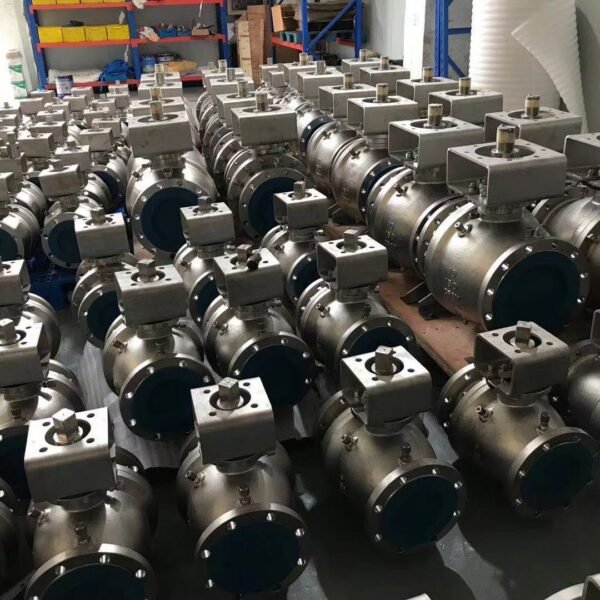
Floating ball valves have the following features: they provide excellent sealing performance, are easy to operate, and can handle high-pressure applications. They are also known for their durability and reliability. Common applications include pipelines in oil, gas, and water industries.
1. Ball valves offer the lowest flow resistance among all valves. When the valve is fully open, the diameter of the entire passageway is consistent with the pipe diameter, ensuring smooth, unobstructed flow. Floating ball valves, in particular, can be fully closed with a 90° rotation, making them extremely convenient and quick to open and close.
2. Compared to other valves, floating ball valves are lightweight and compact, making them suitable for installation in various pipelines. They are also easy to install and offer excellent airtightness, resulting in virtually no leakage during operation. They are particularly effective in throttling gases when conveying them.
3. Floating ball valves incorporate a locking mechanism to minimize the impact of misoperation on valve opening and closing. Specifically, floating ball valves feature locking holes in the fully open and fully closed positions, preventing the valve from opening and closing due to careless handling.
4. The stem of a floating ball valve, typically mounted from below, features a flyaway prevention mechanism to effectively prevent the valve from flying out under pressure. Furthermore, this mechanism is constructed entirely of metal, ensuring a stable seal even in fires and high-temperature environments.